2026-03-15 · Counterforce Research Team
Information Asymmetry: Why Defenders Keep Losing and What Coordinated Response Could Change
By Counterforce AI Research Team | March 2026
TL;DR
Adversaries run coordinated attacks. Defenders improvise. That asymmetry — not a technology gap — is why online misinformation keeps winning. Closing it means building the same structural advantages that make attacks effective in the first place: speed, coordination, and institutional memory.
The Infodemic Is Accelerating — and We're Not Ready
The speed at which false information now travels has outpaced our collective ability to respond. A landmark study by MIT researchers found that false news spreads significantly faster, farther, and deeper than true news across social media platforms, reaching 1,500 people six times faster than accurate stories.[1] This isn't merely a social media problem — it's a structural threat to public health, democratic governance, and social cohesion.
The World Health Organization has warned that we're fighting not just a pandemic, but an "infodemic" — an overabundance of information, some accurate and some not, that makes it difficult for people to find trustworthy sources.[2] During COVID-19, misinformation about vaccines, treatments, and prevention measures spread through every channel imaginable, from WhatsApp groups to mainstream platforms, contributing to measurable harm including vaccine hesitancy and dangerous self-treatment behaviours.[3]
But before we can respond effectively, it helps to be precise about what we're actually defending against. Not all false or harmful content online is the same thing, and the interventions that work for one type can actively fail for another.
The OECD's Going Digital Toolkit offers a useful matrix (see figure below). It plots content on two axes: whether it involves active fabrication (something created to deceive) and whether it was shared with intent to harm. This produces four meaningfully different categories.[4]
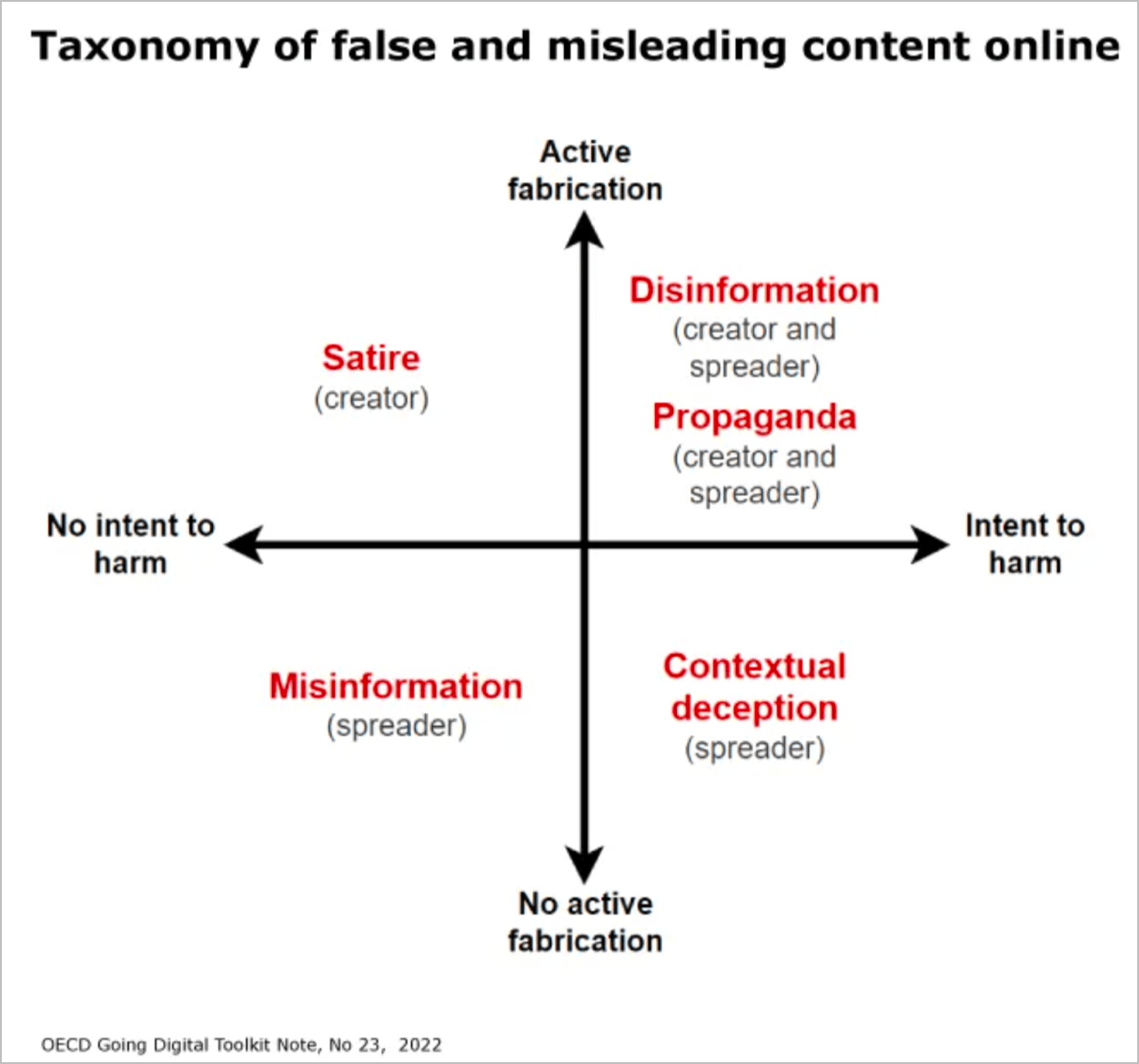
Satire involves fabrication but no intent to harm — and most audiences understand the register. Misinformation spreads without fabrication and without harmful intent; it's often simply people sharing things they genuinely believe are true. Contextual deception is strategically framed real content — accurate facts, stripped of context, deployed to mislead. And disinformation is fabricated content spread with deliberate intent to cause harm.
These distinctions matter enormously for response design. Correcting misinformation spread by well-meaning people requires different tactics than dismantling a coordinated disinformation network. Conflating them produces generic responses that don't fit either problem well — which is exactly what most current approaches do.
Adding to the complexity, the content ecosystem itself is shifting. AI-generated audio, video, and images that appear authentic represent a qualitatively new category of risk. Synthetic media is becoming cheaper, easier to produce, and increasingly difficult to distinguish from genuine content — exploiting the trust we place in visual evidence in ways that earlier text-based manipulation could not.[5]
What the Research Tells Us
The research community has made significant progress mapping the intervention space. A comprehensive systematic review by researchers at The Alan Turing Institute and the Oxford Internet Institute identifies three fundamental stages of effective response.[6]
Prepare: Building Cognitive Immunity
Pre-bunking and media literacy interventions aim to reduce susceptibility before exposure occurs. The evidence is encouraging: Ukraine's "Learn to Discern" programme, which trained over 15,000 citizens and 7,500 students, found that adults were 25% more likely to check multiple news sources and 13% better at identifying false content eighteen months after training.[7]
Psychological inoculation — exposing people to weakened examples of manipulation techniques, much like a vaccine works against a pathogen — has also proven effective. Short games like "Bad News" and "Harmony Square" measurably improve participants' ability to recognise manipulation tactics, and these effects persist for up to two months with booster interventions.[8]
The limitation is reach. Prepare-stage interventions require voluntary participation and often fail to reach the populations most exposed to manipulation. There's also a well-documented risk that some educational approaches increase scepticism toward all content — credible and false alike — which can undermine trust in legitimate sources.[6]
Curb: Limiting Exposure and Spread
Platform-level interventions attempt to slow or stop spread. Fact-check labels demonstrably lower perceived accuracy of flagged content[9], but fact-checking faces a fundamental scalability problem: professional fact-checkers cannot possibly review the volume of content posted daily.
Accuracy prompts — asking users to consider whether a headline is accurate before sharing — show strong, replicable results. A meta-analysis across 20 experiments (N = 26,863) found that accuracy prompts reduced intention to share false headlines by 10%, consistently across demographic groups and topics.[10] Twitter's "read before you retweet" prompt, implemented under the former management, increased article click-through rates by 40%.[11]
Platform interventions do raise legitimate concerns about transparency, fairness, and the concentration of editorial power in companies with limited accountability. When platforms remove content or suspend accounts, they act as de facto arbiters of speech — often with inconsistent standards and minimal due process.
Respond: Correcting False Beliefs
Debunking remains essential when prevention fails. Research shows corrections are most effective when they provide an alternative explanation rather than simply labelling content as false — replacing the false narrative with an accurate one, rather than leaving a gap.[12]
But debunking faces a structural disadvantage: corrections rarely reach the same audience as the original false content. A study of tobacco industry corrective statements found that the mandated campaign reached only a fraction of the population exposed to decades of misleading industry messaging.[13] The content spreads; the correction chases it.
The Gaps the Research Reveals
The Prepare/Curb/Respond framework is well-evidenced. What it doesn't solve is the operational infrastructure problem — and that's where current efforts most consistently fall short.
Speed. Coordinated information operations — state-sponsored influence campaigns, commercial manipulation networks, amplified health misinformation — move at machine speed using automated tools, bot networks, and AI-generated content. Defensive responses route through human analyst queues, editorial review, and institutional approval chains. By the time a response is authorised, the narrative may have already achieved critical diffusion velocity. The content has been seen by the people it was designed to reach.
Readiness. Offensive actors operate from tested, repeatable playbooks. They know what techniques to use, in what sequence, against what types of audiences, and how to measure whether it's working. Defenders improvise. Every response starts from scratch. There is no common operational framework, no shared language for cross-organisational coordination, no institutional memory of what worked in the last campaign. When analysts leave, their knowledge leaves with them.
Scale. A single campaign operator can orchestrate hundreds of coordinated accounts, generating thousands of pieces of content across multiple platforms simultaneously. A human analyst building a deplatforming case for a coordinated network of 50 accounts across three platforms spends 40 to 80 hours on documentation alone — by which time the network may have migrated, evolved, or achieved its objectives.
The research community has mapped the problem with increasing precision. What has been missing is not better evidence. It's the operational infrastructure to act on that evidence at the speed and scale the problem demands.

The Counterforce Approach: Systematic, Agentic Defense
Counterforce AI was built on the premise that information defense needs the same structural advantages that make coordinated attacks effective — speed, reproducibility, and institutional memory — while being architecturally constrained against misuse.
Our platform organises fourteen specialised agent capabilities across three coordinated response stages: SEE (Detect: multimodal signal analysis, source attribution, coordinated behaviour recognition), MAP (Understand: network mapping, influence trajectory modelling, actor profiling), and ACT (Respond: pre-bunking deployment, correction coordination, platform accountability filing). Each stage feeds the next; each action generates structured data that improves future responses.
The result is an agentic system that does more than react, it learns by accumulating the institutional memory that human-only operations lose when teams turn over and campaign records are archived.
Three capabilities are particularly distinctive:
Early Warning. Rather than waiting for false content to go viral, the platform detects emerging narratives in their early diffusion phase and deploys targeted inoculation content before they reach critical velocity. This is the digital equivalent of getting ahead of an outbreak; much harder than responding to one, and far more effective when it works.
Rapid, Evidence-Based Correction. When false content does spread, coordinated correction responses are prepared and queued for human review within hours — not days. Corrections are linked to source evidence and framed as replacements for the false narrative, not just labels against it. The research on what makes corrections work is baked into how the system builds them.
Network Accountability Filing. This is the capability with no current equivalent in the field. Building a deplatforming case file for a coordinated inauthentic network, documenting account behaviour, coordination patterns, and policy violations across multiple platforms would normally take a human analyst 40 to 80 hours per network. The Platform Accountability Agent, one example of an ACT agentic module in the Counterforce technology, reduces that to minutes, generating structured evidentiary case files ready for human review of tailored submission to the specific terms of service for the target platform. It doesn't fatigue. It maintains evidentiary consistency and it can work across platforms simultaneously.
Architectural Constraints: Defense, Not Control
Information defense must not become information control. The difference matters — and in our platform, it's architecturally enforced, not merely stated in a policy document.
The system operates under hard constraints that cannot be overridden:
- No autonomous content removal. Agents build evidentiary case files; humans authorise submission; platforms decide. That chain is structurally enforced — the system cannot submit a case file without human sign-off.
- No narrative substitution. Corrections are evidence-based. The platform does not replace one manipulative narrative with another.
- Full attribution. All content produced is clearly attributed. There is no mechanism for astroturfing or covert grassroots simulation.
- Equity-first targeting. The most vulnerable populations are prioritised, not the largest audiences.
- Human approval required before any public-facing action. Constitutional AI guardrails gate every piece of content released. This is a hard architectural requirement.
We mention these not as reassurances but as design specifications. A platform with this much operational capability needs to be trustworthy by construction, not by declaration.
The Path Forward
The challenge of the emerging information ecosystem isn't a technology problem awaiting a technical fix. It's an operational challenge that's lacking a common framework to enable defenders the abilities to match the speed, coordination, and institutional learning of the adversaries they're trying to counter.
That means shared situational awareness across platform and organizational boundaries. It means coordinated response that operates on the same timescale as content diffusion. It means systematic measurement of what actually works, not just what gets deployed. And it means building the kind of cumulative operational knowledge that currently lives only in individual analysts' heads, if it exists at all.
Counterforce AI is building toward that infrastructure. We're actively seeking collaborators — researchers, platform operators, civil society organisations, and public health institutions — to help establish the shared standards and protocols that information defense still lacks.
The people spreading coordinated misinformation have playbooks. It's time defenders did too.
Learn more about the platform at counterforce.tech
References
[1]: Vosoughi, S., Roy, D., & Aral, S. (2018). The spread of true and false news online. Science, 359(6380), 1146–1151. https://doi.org/10.1126/science.aap9559
[2]: World Health Organization. (2022). Managing the COVID-19 infodemic: Promoting healthy behaviours and mitigating the harm from misinformation and disinformation. WHO Joint Statement. https://www.who.int/news-room/feature-stories/detail/countering-misinformation-about-covid-19
[3]: Dharawat, A., Lourentzou, I., Morales, A., & Zhai, C. (2022). Drink bleach or do what now? COVID-HeRA: A study of risk-informed health decision making in the presence of COVID-19 misinformation. Proceedings of the International AAAI Conference on Web and Social Media, 16, 1218–1227. https://doi.org/10.1609/icwsm.v16i1.19372
[4]: OECD. (2022). Disinformation and Russia's war of aggression against Ukraine: Threats and policy responses. OECD Going Digital Toolkit Note, No. 23. https://doi.org/10.1787/5e9571e6-en
[5]: Prier, J. (2017). Commanding the trend: Social media as information warfare. Strategic Studies Quarterly, 11(4), 50–85.
[6]: Johansson, P., Enock, F., Hale, S., Vidgen, B., Bereskin, C., Margetts, H., & Bright, J. (2023). How can we combat online misinformation? A systematic overview of current interventions and their efficacy. The Alan Turing Institute & Oxford Internet Institute. https://ssrn.com/abstract=4648332
[7]: Murrock, E., Amulya, J., Druckman, M., & Liubyva, T. (2018). Winning the war on state-sponsored propaganda: Results from an impact study of a Ukrainian news media and information literacy programme. Journal of Media Literacy Education, 10(2), 53–85.
[8]: Roozenbeek, J., & van der Linden, S. (2020). Breaking Harmony Square: A game that "inoculates" against political misinformation. Harvard Kennedy School Misinformation Review. https://doi.org/10.37016/mr-2020-47
[9]: Clayton, K., Blair, S., Busam, J. A., Forstner, S., Glance, J., Green, G., Kawata, A., Kovvuri, A., Martin, J., & Morgan, E. (2020). Real solutions for fake news? Measuring the effectiveness of general warnings and fact-check tags in reducing belief in false stories on social media. Political Behavior, 42(4), 1073–1095.
[10]: Pennycook, G., & Rand, D. G. (2022). Accuracy prompts are a replicable and generalizable approach for reducing the spread of misinformation. Nature Communications, 13(1). https://doi.org/10.1038/s41467-022-30073-5
[11]: Hutchinson, A. (2020, June 10). Twitter is adding a new prompt on retweets when users haven't opened the link. Social Media Today. https://www.socialmediatoday.com/news/twitters-adding-a-new-prompt-on-retweets-when-users-havent-opened-the-lin/579595/
[12]: Ecker, U. K. H., Lewandowsky, S., & Tang, D. T. (2010). Explicit warnings reduce but do not eliminate the continued influence of misinformation. Memory & Cognition, 38(8), 1087–1100.
[13]: Kostygina, G., Szczypka, G., Tran, H., Binns, S., Emery, S. L., Vallone, D., & Hair, E. C. (2020). Exposure and reach of the US court-mandated corrective statements advertising campaign on broadcast and social media. Tobacco Control, 29(4), 420–424. https://doi.org/10.1136/tobaccocontrol-2018-054762
© 2026 Counterforce AI. All rights reserved.